Gerry Smith | Zoe
Danielle Arnaud, London, July 2019
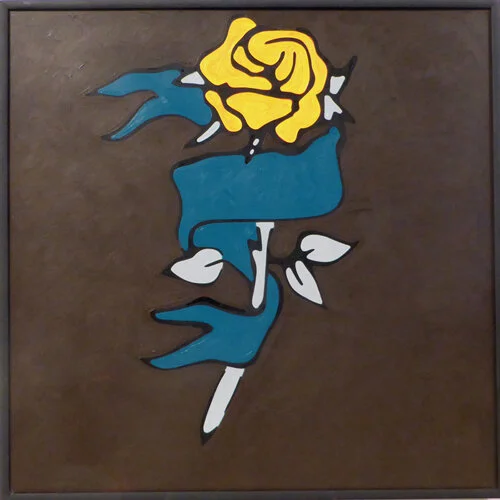
Gerry Smith, Zoe, 2019, Oil on board, 61x61cm. Image courtesy the artist and Danielle Arnaud, London.
Gerry Smith’s house-cum-studio is brimming with art, both his own and the work of other artists. The space is carefully curated, with close but playful attention paid to the dialogues that arise between different works. On visiting Smith, this is one of the first things we talk about; I learn about his practice through learning about his home. Naming Belgian artist Marcel Broodthaers as one of his primary influences, he references Broodthaers’ statement that he liked to make art the way people arrange their mantelpieces. Smith alludes to this literally in the arrangement of his own mantelpieces which are composed with a combination of art and objects (some collected specifically for the purpose of this positioning). The mantelpieces become works in themselves, cabinets of curiosities. Subverting Broodthaers’ statement, Smith has arranged them as people would curate a show or compose a painting. His interpretation and evolution of this statement is akin to his practice; figurative yet flat and washed with something a little humorous, something a little dark.
Before becoming an artist, Smith worked for several years as a gardener. He describes himself as ‘flower mad’ and flowers do crop up repeatedly in his paintings. His interest in flowers has evolved into a fascination with the strange simplicity of their portrayal in tattoos. Zoe is a painting of a rose, tattooed, and is typical of Smith’s style in its flatness. Rejecting layers, he paints each colour side by side, playing with the viewer’s perception. The strokes of Zoe’s brown background follow the outline of her rose almost like an aura, until they merge into their murky expanse. This technique creates tension between the marks, which Smith likens with the tension created when air touches water. He approaches art as something immersive and consuming, comparing it to the moment of letting go of the rail in a swimming pool when you know you can’t swim. ‘But, with art’, he says, ‘people won’t allow themselves to let go of the rail and just experience it. See what it says to you.’
On close examination, the name ‘Zoe’ is just visible on the banner of green below the rose’s flower. Camouflaged by its colour, the name is only distinguishable because the direction of the brushstrokes spelling each letter interrupts the plane of green. His technique here mirrors the repetitive tracing of the tattooist’s needle. The painting grew from a story Smith saw in the news, of a young girl being pulled out of the Thames. Her body was identified by a tattoo of a rose on which was written her name, Zoe.
Smith experimented with having the name written clearly on the painting but found that it didn’t look right, it was too obvious. Here is the mystery in art that he is drawn to; the idea that a work of art can be ‘unwrapped like a child’s game to find that there is nothing in the middle.’ Or that what we thought was a flower was in fact a point of identification and the only mark that anchored this woman to the world. Zoe holds a secret but doesn’t demand for it to be known. The painting works regardless. Yet the brown of the background takes on a watery shade when its mystery is unfurled.