Kathleen Herbert | They Take Us Away to the Thin World of the Future or the Underworld of the Past
Danielle Arnaud, London, December 2019
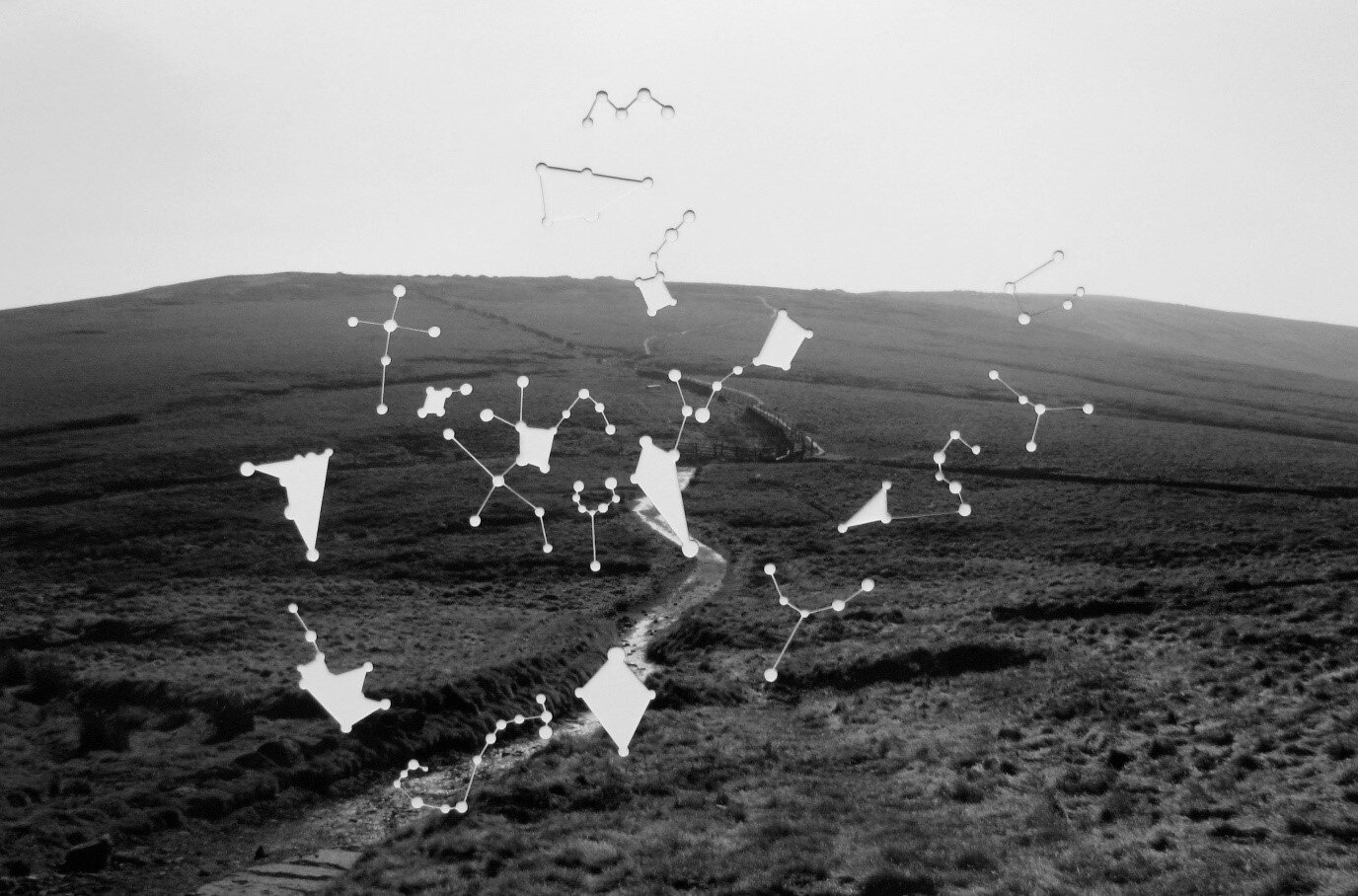
Kathleen Herbert , They Take Us Away to the Thin World of the Future or the Underworld of the Past VI, 2013, Series of 12 black and white giclée prints, lasercut star constellation, 48 x 28cm, Edition of 5. Image courtesy the artist and Danielle Arnaud.
Paths are ways trodden; routes formed by the weight of bodies imprinting upon the earth repeatedly. In this series, the title of which is a quote by poet Edward Thomas, Herbert has photographed the landscape of the Peak District, where in 1932 approximately 500 walkers walked from Hayfield to Kinder Scout to challenge the right of landed gentry to enclose the countryside and to secure access rights to open country. These paths represent a shared history; a marking of humanity’s living amongst each other across generations and even lifetimes. Traces of our ancestors exist in our landscapes and we map traces anew. The idea of the future as a ‘thin world’ seems particularly relevant now, in the destructiveness of the ecological impact we have pressed upon the earth.
Herbert captures the landscape here in its fleeting state of fluctuation. As with all photography, we see a truth for the instant of the image’s exposure; its aura impossible to replicate. Herbert allows the viewer to project themselves onto the image, not only with their viewpoints, typically at eye-level looking out onto the landscape, but also with the way in which she has worked into the photographs after their printing. Each photograph of the series of twelve, for every month of the year, has been lasercut with one of the twelve astrological constellations. Without knowledge of the constellation patterns, this could at first appear to be a join-the-dots game or coordinates on a map, rather than coordinates on the celestial sphere. The fact that these constellations are cut out of the image, rather than overlaid, allows the viewer to project herself upon the image, choosing what can be seen between the stars. Constellations are mappings, points of orientation, but they are also invitations for imagination; sketches of lost pasts or imagined futures to be coloured in our continual quest to understand, to relate our position within the world. Herbert’s work here is a reflection of our desire to simultaneously evade and embrace the unknown.