Louisa Fairclough | Bore Song
Danielle Arnaud, London, August 2020
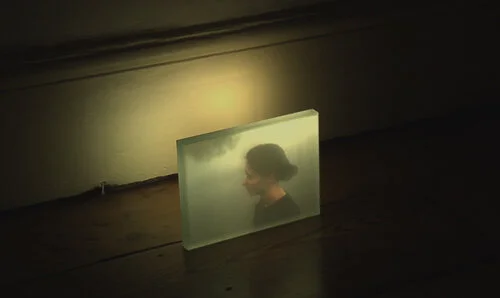
Louisa Fairclough, Bore Song, 2011, 16mm film loop with sound projected on float glass
Louisa Fairclough’s Bore Song speaks grief’s language to those who know it, and cannot fail to move those who don’t. I watch it in early June, days before the third anniversary of my mother’s death and I have to look away. As the figure in the film calls to the water, a discordant minor note, something in the work meets a primal sense of loss; a need to shout, to call out to a presence beyond response. I return to it weeks later and this time can watch it repeatedly, able to notice its nuances, to appreciate it beyond self-identification. In this way, my experience with the work mimics the pattern of grief itself. Sometimes it overwhelms you, its rawness an eruption. But mostly it is just there, a hum in your existence. The sound of water lapping on the shore. Grief is often compared to a wave and in Fairclough’s film the metaphor becomes literal. A bore tide surges, the singer (the bereaved) surrounded but not submerged.
The materiality of the work, and the form of its presentation, is crucial. First presented at the gallery in 2011, it was shown alongside Song of Grief, the sounds of the two works merging to create a minor sixth. The film is projected onto float glass, its ephemeral quality a manifestation of the slippery nature of bereavement. This is a work of loss, yes, but mostly of human experience; of the melancholy song we all sing, at some point or another.